What Does It Mean to Buy a YouTube Channel?
Buying a YouTube channel means acquiring an existing YouTube channel from another owner and taking control of the digital asset.
Depending on the channel, you may be acquiring an established audience, existing content, watch history, subscribers, traffic, monetization status, brand presence, and revenue potential.
However, buying a channel is not simply about purchasing a subscriber count.
The real value comes from the quality of the audience, the content history, the traffic sources, the niche, the monetization history, and the channel's potential for future growth.
Why Buy a YouTube Channel Instead of Starting From Scratch?
Starting a YouTube channel from zero can take significant time because you have to build an audience, establish content history, generate watch time, test topics, and discover what works.
An established channel can potentially give you a head start.
Instead of beginning with zero subscribers and no content history, you may acquire an asset that already has audience data and an existing content foundation.
But speed should never be the only reason to buy.
A poor-quality channel can create more problems than it solves.
- Existing audience
- Established content history
- Existing traffic
- Previous audience data
- Potential monetization
- Existing brand presence
- Faster starting point
What Makes a YouTube Channel Valuable?
Not every YouTube channel has the same value.
Two channels with the same number of subscribers can have completely different business value.
A channel's value depends on multiple factors, including audience quality, monthly views, engagement, revenue, niche, traffic sources, content quality, monetization history, growth trends, and the strength of the channel's brand.
The most important question is not how many subscribers the channel has.
The question is whether the audience and traffic can continue producing meaningful results after the acquisition.
- Niche and audience demand
- Monthly views
- Subscriber quality
- Audience geography
- Engagement
- Revenue history
- Traffic sources
- Content quality
- Growth trend
- Monetization status
- Copyright and policy history
Step 1: Choose the Right YouTube Niche
Before looking for channels to buy, decide what type of audience and business you want to build.
The niche matters because it determines the type of audience you inherit and the type of content you can publish after the acquisition.
Ideally, the channel should be related to the business or content direction you plan to pursue.
A channel with a strong audience in one topic may perform poorly if you suddenly change the content completely.
Think about the audience first, not just the subscriber number.
- Business
- Technology
- AI
- Education
- Finance
- Entertainment
- Gaming
- Documentaries
- Lifestyle
- Product-focused content
Step 2: Analyze the YouTube Analytics Before Buying
Never evaluate a YouTube channel based only on screenshots showing subscribers and total views.
You need to understand how the channel actually generates traffic.
Ask the seller for access to relevant analytics or verifiable reports before making a purchase.
Look at recent performance rather than relying only on lifetime numbers.
A channel that received millions of views several years ago but now receives almost no traffic is very different from a channel with consistent recent performance.
- Recent views
- Watch time
- Impressions
- Click-through rate
- Average view duration
- Audience retention
- Traffic sources
- Returning viewers
- Subscriber growth
- Top-performing videos
- Recent revenue
Step 3: Check the Audience Quality
Subscriber count can be misleading.
You need to understand who actually watches the channel.
Review audience geography, age ranges, interests, returning viewers, engagement, and traffic sources where available.
For many businesses, audience geography is especially important because advertisers and customers in different markets can have very different commercial value.
A channel with a smaller but relevant audience can be more valuable than a larger channel with an audience that does not match your target market.
- Top countries
- Audience demographics
- Returning viewers
- Engagement quality
- Viewer interests
- Traffic sources
- Audience relevance to your business
Step 4: Review the Channel's Content History
Study the channel's existing videos before buying it.
Look at the topics, upload frequency, video quality, titles, thumbnails, formats, and performance patterns.
Identify which videos generated the majority of the channel's traffic.
This can help you understand whether the channel has a repeatable content opportunity or whether its performance depended on one unusual viral video.
You should also check whether the existing content is compatible with the direction you want to take the channel.
- Top videos
- Recent uploads
- Content topics
- Upload consistency
- Titles and thumbnails
- Video formats
- Performance patterns
- Content quality
Step 5: Check Monetization and Revenue History
If a channel is monetized, verify the monetization status rather than accepting a seller's claim at face value.
Review the revenue history and understand where the revenue comes from.
A channel can have high views but relatively low commercial value depending on its audience, niche, geography, and content.
Revenue should also be evaluated over a meaningful period rather than based on one unusually strong month.
If the seller claims the channel generates consistent revenue, request evidence that supports the claim.
- Current monetization status
- Recent revenue
- Revenue consistency
- Revenue sources
- Audience geography
- Views supporting the revenue
- Historical performance
Step 6: Check Copyright and Policy History
A channel can look attractive on the surface while carrying significant risks underneath.
Before buying, review its copyright history, community guideline status, reused-content issues, strikes, claims, and other policy-related concerns.
A channel with unresolved policy problems can become a serious liability.
Do not assume that an existing monetized status automatically means the channel is free from future risk.
The goal of due diligence is to understand what you are actually acquiring.
- Copyright strikes
- Copyright claims
- Community guideline strikes
- Reused-content concerns
- Monetization restrictions
- Policy warnings
- Content ownership
Step 7: Verify Ownership and Transfer Details
Before paying, make sure the seller actually owns the channel and has the authority to transfer control.
The transfer process should be planned carefully so that ownership, associated assets, and account access are handled securely.
Do not rely on informal promises.
Document what is included in the transaction and confirm exactly what you will receive after payment.
This may include the channel itself, brand assets, content files, social accounts, websites, or other digital assets if they are part of the agreement.
- Verify the seller's ownership
- Confirm what assets are included
- Document the transaction
- Use a secure payment process
- Confirm the transfer process
- Secure the account after transfer
Where Can You Buy a YouTube Channel?
You can encounter YouTube channels for sale through private sellers, digital asset marketplaces, brokers, communities, and direct business networks.
The important part is not simply where you find the channel.
It is whether you can verify the asset and complete proper due diligence before purchasing.
Avoid making decisions purely because a listing looks cheap or because the seller claims that a channel is guaranteed to grow.
- Direct owners
- Digital asset marketplaces
- Brokers
- Business networks
- Creator communities
- Specialized channel sellers
How Much Does a YouTube Channel Cost?
There is no single fixed price for a YouTube channel.
The value can vary significantly depending on the niche, audience, traffic, revenue, monetization status, content history, and growth potential.
A small established channel may have a relatively low acquisition cost, while a channel with strong revenue, a valuable audience, and consistent growth can command a much higher price.
Instead of asking only how many subscribers you are getting for the price, compare the purchase price against the quality of the underlying business asset.
- Subscribers
- Monthly views
- Revenue
- Profit potential
- Audience geography
- Niche value
- Growth trend
- Content library
- Monetization status
- Risk level
The Biggest Risks When Buying a YouTube Channel
Buying an established channel can accelerate your starting point, but it also introduces risks that do not exist when creating a channel from scratch.
The biggest risk is buying based on numbers without understanding what created those numbers.
A channel may have fake engagement, poor-quality subscribers, declining traffic, policy problems, or an audience that is completely unrelated to your intended content.
You should therefore treat every acquisition as an investment that requires due diligence.
- Fake or low-quality engagement
- Declining traffic
- Audience mismatch
- Copyright problems
- Policy violations
- Unverified revenue claims
- Seller fraud
- Poor transfer process
- Overpaying for vanity metrics
How to Avoid YouTube Channel Buying Scams
Scams often rely on urgency, unrealistic promises, fake screenshots, or pressure to send money before the buyer has verified the asset.
Do not rush because a seller says someone else is ready to purchase the channel.
Ask for evidence, verify information independently, document the deal, and use a payment process that provides appropriate protection.
If the seller refuses reasonable verification or creates unnecessary pressure, treat that as a warning sign.
- Verify analytics
- Verify ownership
- Check the content history
- Review policy and copyright status
- Verify revenue claims
- Document the transaction
- Avoid pressure-based decisions
- Use secure payment procedures
What to Do Immediately After Buying a YouTube Channel
The acquisition is only the beginning.
Once ownership has been transferred, secure the account and review the entire channel before making major changes.
Do not immediately delete the existing content or completely change the niche without understanding the audience.
First, study what has already worked and create a transition plan.
- Secure account access
- Review channel settings
- Verify monetization status
- Review analytics
- Audit existing content
- Check audience data
- Review branding
- Create a transition strategy
- Plan the next content batch
How to Grow a Purchased YouTube Channel
The best way to grow a purchased channel is usually to build on what already works rather than destroying the existing audience connection.
Start by identifying the topics and formats that historically performed well.
Then test new content that is closely related to those successful patterns.
Improve titles, thumbnails, scripts, editing, retention, and publishing consistency while carefully monitoring the audience response.
Over time, you can gradually expand the channel into adjacent topics if the audience responds positively.
- Study historical winners
- Improve thumbnails
- Improve titles
- Strengthen hooks
- Increase retention
- Publish consistently
- Test related topics
- Monitor audience response
- Build a repeatable content system
How to Turn a YouTube Channel Into a Real Business
A YouTube channel becomes more valuable when it is connected to a broader business model.
Instead of relying entirely on advertising revenue, you can potentially use the audience to support additional revenue streams.
The right model depends on the niche and audience.
For example, a business or software-focused channel may support affiliate offers, lead generation, services, or digital products.
The goal is to turn attention into an asset that can generate multiple forms of value.
- Advertising
- Affiliate marketing
- Sponsorships
- Digital products
- Services
- Lead generation
- Ecommerce
- Memberships
Should You Buy a Monetized YouTube Channel?
A monetized channel can be attractive because it may already have an established content and revenue history.
However, monetization alone does not make a channel valuable.
You still need to evaluate the audience, content quality, revenue consistency, policy history, niche, traffic sources, and future growth potential.
If the channel is monetized but has declining traffic or an irrelevant audience, the monetization status may not justify the purchase price.
Think about the entire asset rather than one feature.
A Simple YouTube Channel Acquisition Checklist
Before completing a purchase, work through a structured checklist.
The objective is to understand the asset, identify risks, and make the acquisition based on evidence rather than excitement.
- Define your target niche
- Review recent analytics
- Analyze audience quality
- Check top traffic sources
- Review content history
- Verify monetization
- Review revenue history
- Check copyright and policy history
- Verify ownership
- Confirm transfer details
- Document what is included
- Use a secure payment process
- Create a post-acquisition growth plan
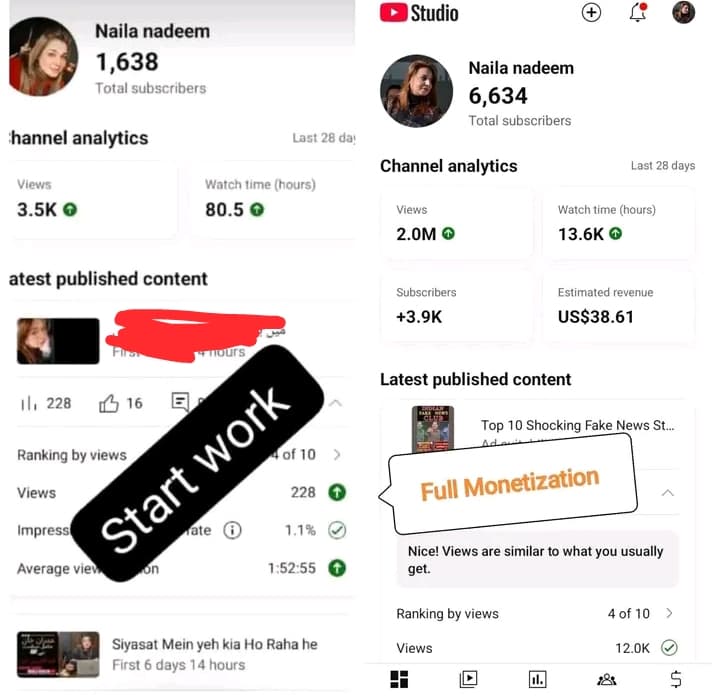
Real YouTube Growth Case Study: Naila Nadeem
Buying or acquiring a YouTube channel is only the beginning. The real opportunity comes from understanding the existing audience, improving content performance, and building a repeatable growth system.
A real YouTube growth example from Exozi's case studies shows how stronger content performance and audience development can translate into significant channel reach.
The Naila Nadeem YouTube channel growth case study focuses on increasing reach, improving content performance, and building a larger YouTube audience.
- 2.0M views
- 13.6K watch hours
- +3.9K new subscribers
- Focus: reach, content performance, and audience development
Final Thoughts: Buy the Asset, Not Just the Numbers
Buying a YouTube channel can provide a faster starting point than building from zero, but the quality of the acquisition determines whether that advantage is real.
Subscribers, views, and revenue screenshots are only part of the picture.
The real value lies in the audience, content history, traffic quality, monetization potential, brand, and ability to continue growing the asset.
Do your due diligence before purchasing.
Verify the numbers, understand the audience, review the risks, and make sure the channel fits the business you want to build.
The goal is not simply to buy a YouTube channel.
The goal is to acquire a digital asset that can become more valuable over time.