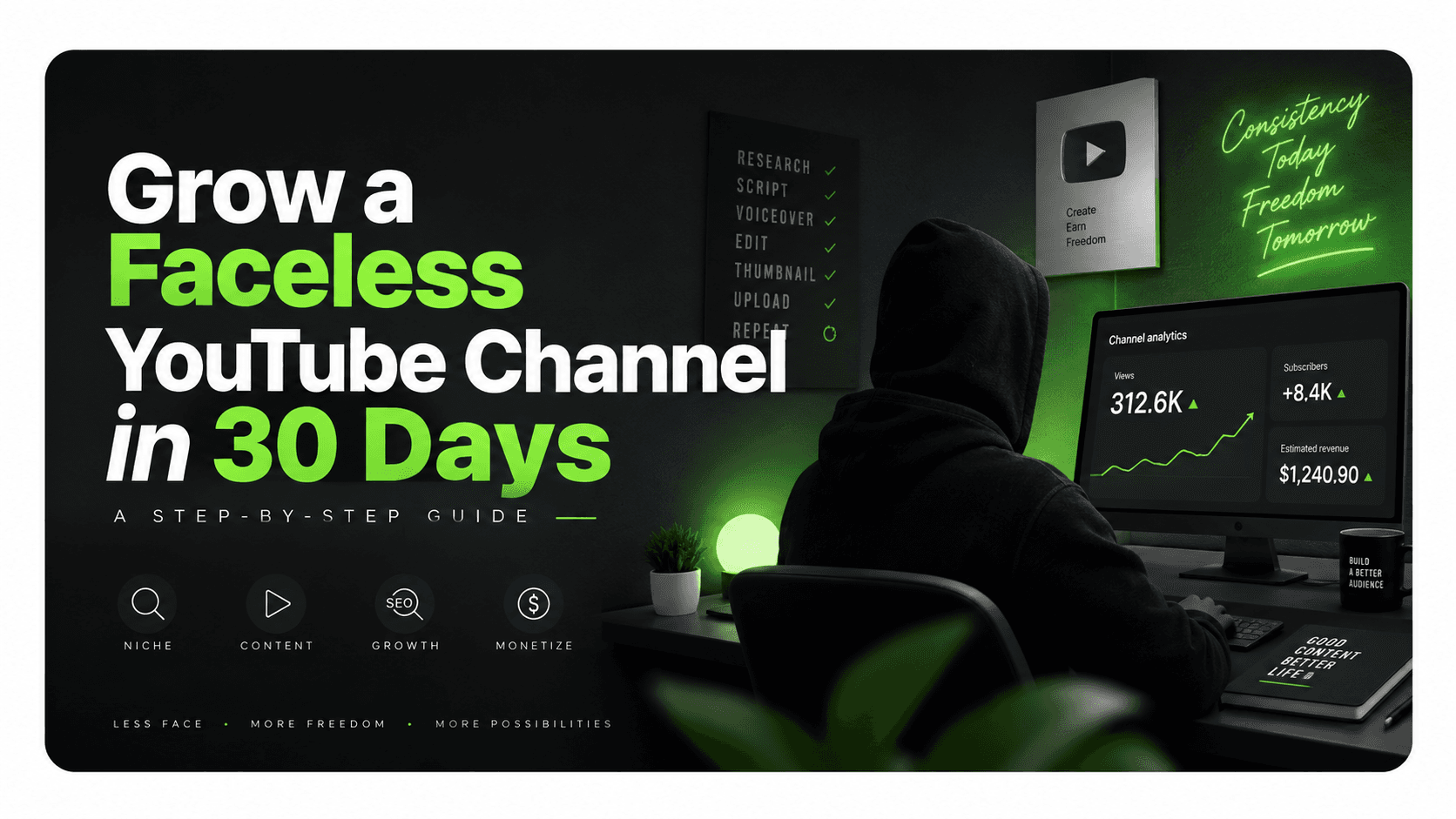
What Makes a Faceless YouTube Channel Successful?
A faceless channel is not simply a channel where the creator doesn't appear on camera.
It is a content business built around a repeatable production system.
Instead of depending on the creator's personality or physical presence, the channel relies on strong topics, compelling titles, high-quality thumbnails, engaging scripts, voiceover or narration, visual storytelling, audience retention, consistent publishing, strategic YouTube SEO, and a clear monetization model.
This means you can build a recognizable channel without necessarily becoming the face of the brand.
The biggest mistake is thinking that automation alone creates growth.
Tools can make production easier. Strategy creates direction.
- Strong topics
- Compelling titles
- High-quality thumbnails
- Engaging scripts
- Voiceover or narration
- Visual storytelling
- Audience retention
- Consistent publishing
- Strategic YouTube SEO
- A clear monetization model
Step 1: Choose the Right Niche
Before creating your first video, decide what your channel is going to be about.
A strong niche gives YouTube a clearer understanding of your content and helps your audience know why they should subscribe.
Look for a topic that has three characteristics: existing audience demand, enough content opportunities, and monetization potential.
However, choosing a popular niche isn't enough.
Your goal should be to find a specific angle within the niche.
For example, instead of creating a general technology channel, you could focus specifically on AI tools for businesses.
That gives your content a much clearer positioning.
- Business
- Personal finance
- Technology
- AI
- History
- Documentaries
- Education
- Productivity
- Self-improvement
- Entertainment
- News and commentary
Step 2: Define Who Your Channel Is For
Once you've selected a niche, identify the person you're creating content for.
Ask who watches this type of content, what problems they have, what questions they are searching for, what videos they already watch, what would make them click, and what would make them watch until the end.
This research becomes the foundation of your content strategy.
A successful channel isn't built around what video you want to make. It is built around what your audience wants to watch.
Step 3: Research Topics Before Making Videos
One of the biggest mistakes new creators make is producing videos based entirely on random ideas.
Instead, build a topic research system.
Study videos receiving strong views, recently successful uploads, recurring questions, trending subjects, search queries, competitor channels, and comments or audience discussions.
You are not trying to copy another creator. You are looking for patterns.
If multiple channels in your niche are getting strong engagement around a particular problem, that can indicate audience demand.
Then ask: How can we cover the same underlying problem from a better or different angle?
This gives you an evidence-based starting point rather than relying entirely on guesswork.
Step 4: Create a Strong Video Concept
A good topic still needs a strong concept.
Consider the difference between a broad idea such as AI Tools You Should Know and a specific promise such as 7 AI Tools That Can Save a Small Business 20+ Hours Every Week.
The second creates a clearer promise.
A strong video concept should make the viewer understand what they will learn, why it matters, and why they should watch now.
Before producing the video, write down the video's core promise in one sentence.
If you cannot explain the value clearly, the concept probably needs more work.
Step 5: Write Scripts for Retention
A faceless YouTube video depends heavily on its script because the viewer cannot rely on the creator's personality or physical presence to maintain attention.
Your script needs a strong opening.
Avoid spending the first 30 seconds explaining your channel. Instead, quickly establish the problem, the curiosity, and the promise.
Then continue building curiosity throughout the video.
The objective isn't simply to make the video longer.
It is to make every section worth watching.
- Hook — capture attention immediately.
- Context — explain why the topic matters.
- Main content — deliver useful information progressively.
- Open loops — create reasons for viewers to continue watching.
- Payoff — deliver the promised information.
- CTA — give viewers a logical next action.
Step 6: Use AI to Improve Production — Not Replace Strategy
AI tools can significantly reduce the amount of time required to produce faceless content.
They can assist with topic research, brainstorming, script development, voice generation, visual creation, editing, thumbnail concepts, and content repurposing.
But there is an important distinction.
AI should support the creative process, not remove the human strategy behind it.
If you publish generic AI-generated videos without research, differentiation, editing, or quality control, automation can simply help you produce more mediocre content.
The goal is not to produce more videos.
The goal is to produce better videos consistently.
Step 7: Build Click-Worthy Thumbnails
Getting someone to watch your video starts before they ever hear the first sentence.
They need to click.
That is why thumbnails and titles are critical parts of YouTube growth.
A good thumbnail should communicate the idea quickly.
Avoid filling the thumbnail with unnecessary text or too many visual elements.
Your title and thumbnail should work together.
Don't make them say exactly the same thing.
The thumbnail can create the visual question while the title provides additional context.
- One clear subject
- Strong visual hierarchy
- Simple composition
- High contrast
- Curiosity
- A clear relationship with the title
Step 8: Optimize Your YouTube Videos for Search
YouTube is both a social platform and a search engine.
YouTube SEO can help your videos become discoverable when people are actively looking for information.
Avoid stuffing keywords everywhere.
The goal is not to write for an algorithm.
The goal is to make it easier for both YouTube and viewers to understand your content.
- Video title — include the primary topic naturally while keeping the title compelling.
- Description — explain what the video covers and include relevant contextual terms.
- Chapters — organize longer videos into useful sections where appropriate.
- Transcript — a clear spoken structure helps communicate the subject of the video.
- Topic relevance — the entire video should consistently satisfy the search intent behind the topic.
Step 9: Focus on Audience Retention
Views tell you how many people clicked.
Retention tells you what happened after they clicked.
If viewers leave quickly, you have a problem.
Potential reasons include a weak opening, slow pacing, too much introduction, repetitive information, poor storytelling, unnecessary sections, weak visuals, or a misleading title or thumbnail.
Review your analytics after publishing.
Look for moments where viewers drop off.
Then ask what happened here.
Was the information repetitive? Did the video become too slow? Was the visual presentation weak? Was the promise of the video not being delivered?
This feedback becomes extremely valuable for your next upload.
Step 10: Create a Repeatable Content System
One successful video is not a business.
A channel needs a repeatable system.
Instead of treating every upload as a completely new project, create a workflow.
This makes production easier to manage and allows you to identify where your process is slowing down.
You can also create templates for research, scripts, editing, thumbnails, descriptions, uploads, and analytics reviews.
Over time, the system becomes faster and more consistent.
- Research
- Topic
- Title
- Thumbnail Concept
- Script
- Voiceover
- Editing
- Upload
- Analytics
- Improvement
Step 11: Don't Chase Viral Views Alone
A video receiving one million views sounds impressive.
But views alone don't tell you whether the channel is actually growing into a valuable business.
You should also consider the quality of the audience and whether that attention leads to meaningful outcomes.
A smaller audience that trusts your content and takes action can sometimes be more valuable than a huge audience with no commercial intent.
That's why monetization should be considered before the channel becomes large.
- Subscribers
- Watch time
- Audience quality
- Returning viewers
- Engagement
- Click-through rate
- Retention
- Revenue
- Leads
- Product sales
- Affiliate conversions
Step 12: Build Your Monetization Strategy Early
YouTube advertising is only one possible revenue source.
Depending on your niche and audience, a faceless channel can potentially support multiple revenue streams.
The right model depends on the audience.
For example, a business-focused channel could generate revenue through software affiliates, digital products, consulting, or lead generation.
A product-focused channel could combine content with ecommerce or affiliate offers.
The important point is to build an audience around a topic where there is a logical path from attention to revenue.
- YouTube advertising revenue
- Affiliate marketing
- Digital products
- Sponsorships
- Memberships
- Services
- Lead generation
- Ecommerce products
Step 13: Analyze Every Video and Improve
Your first videos probably won't be perfect. That's normal.
The goal is to use every upload as feedback.
After publishing, review your performance data and compare your strongest videos with your weakest ones.
Look for patterns.
Maybe certain topics consistently outperform others. Maybe your audience responds better to specific titles. Maybe your retention improves when you shorten the introduction.
These insights should influence your next batch of content.
Growth becomes easier when every upload teaches you something.
- Impressions
- Click-through rate
- Average view duration
- Audience retention
- Subscribers gained
- Traffic sources
- Returning viewers
- Engagement
The Faceless YouTube Growth Framework
Putting everything together, the process looks like this:
This is the difference between randomly uploading videos and building a YouTube growth system.
- Choose a niche
- Understand the audience
- Research proven topics
- Develop stronger video concepts
- Write retention-focused scripts
- Produce high-quality visuals and voiceovers
- Create compelling titles and thumbnails
- Optimize the video for discovery
- Publish consistently
- Analyze retention and performance
- Improve the next video
- Build a monetization system
How Long Does It Take to Grow a Faceless YouTube Channel?
There is no reliable timeframe that guarantees a channel will become successful.
Some channels gain traction quickly. Others take months of testing before finding the right combination of topic, packaging, and content.
Your results can depend on your niche, content quality, topic selection, upload frequency, audience demand, competition, titles and thumbnails, retention, distribution, and monetization strategy.
Instead of asking how you can guarantee a specific number of views in 30 days, a better question is how you can build a system that consistently improves the probability of growth.
That mindset leads to better long-term decisions.
Final Thoughts
Building a faceless YouTube channel in 2026 is less about finding one secret tool and more about building a repeatable content system.
The technology makes production easier.
But technology alone does not create an audience.
You still need the right niche, strong ideas, compelling packaging, engaging scripts, good editing, audience retention, YouTube SEO, consistent execution, and a clear monetization strategy.
The creators who treat YouTube like a system — rather than a collection of random uploads — have a much stronger foundation for long-term growth.
The goal isn't simply to get views.
The goal is to turn attention into an audience, and an audience into a sustainable digital business.